Behavioural Interview Questions & Follow-Up Guide
Behavioural rounds are not won by rehearsed stories.
60+ questions · 200+ follow-ups · 73 pages
They're won by answers that survive follow-ups about what you actually decided, what went wrong, and what you'd do differently.
Current price · one-time payment
About ₹50 per focused module
Lock in ₹499 for this edition
Downloadable PDF · no subscription · yours to keep
Free sample
Most question lists stop at the first question. Interviews don't.
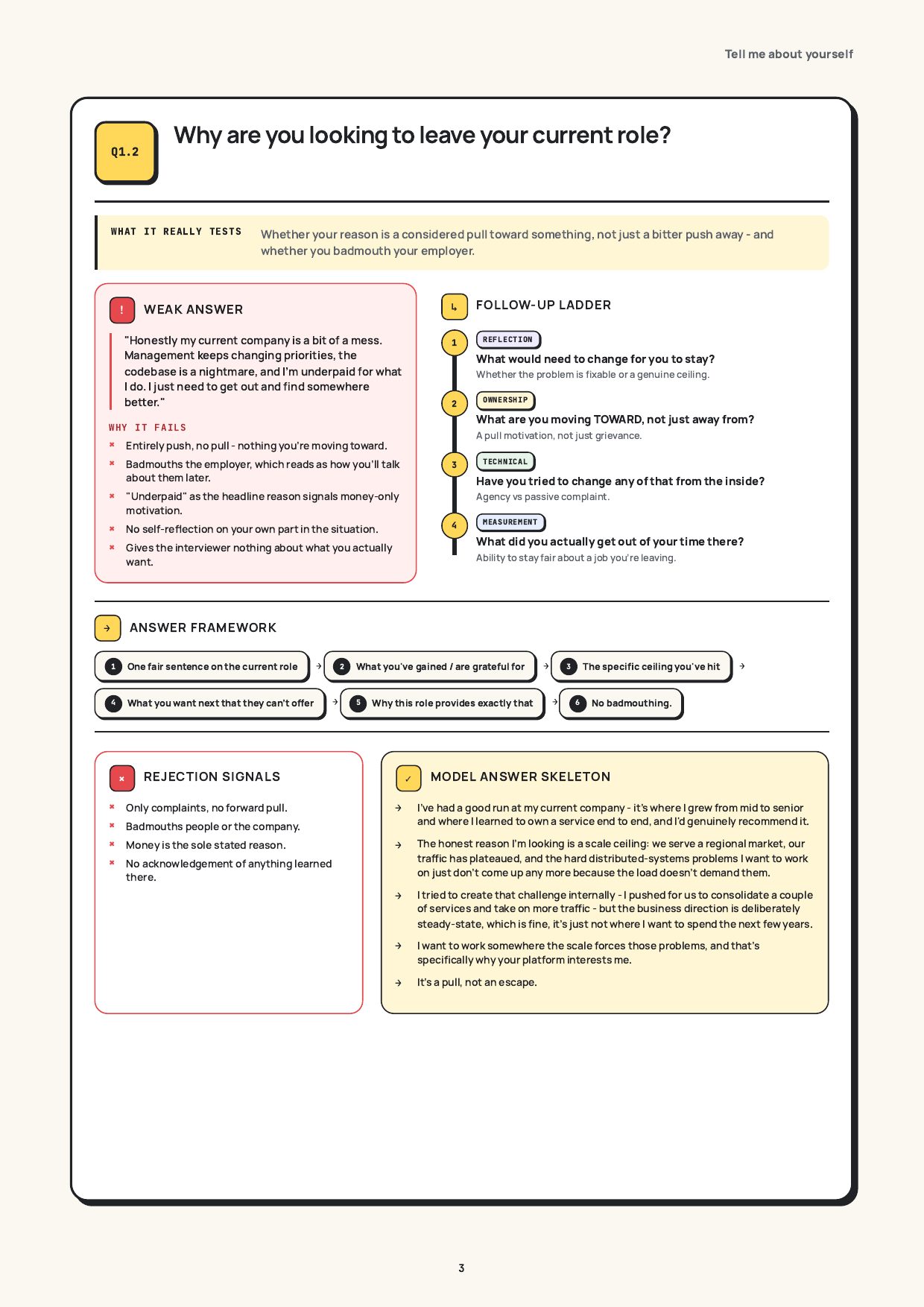
Actual pages from the guide, not a summary of them.
Continue your preparation
Preparing for another interview round?
Backend + Deep-Dive Kit
The Backend question guide plus 26 deep dives across Kafka, Redis, PostgreSQL and six more.
HLD + LLD Interview Kit
Prepare for the architecture and machine-coding rounds together.
AI Engineer Guide
A structured PDF interview guide for experienced software engineers moving into AI Engineer and Applied AI roles. It helps you translate existing strengths in APIs, data, distributed systems, reliability and trade-offs into credible answers about LLMs, RAG, evaluation, agents, cost, safety and production AI systems, without pretending to be an ML researcher.
One way to use this
A preparation roadmap
A suggested pace depending on how far out your interview is. Go slower or faster; the modules don’t have to be used in this order.
- D1Project and ownership questions
- D2Core role fundamentals
- D3Architecture and design decisions
- D4Failure and debugging questions
- D5Production and performance questions
- D6Behavioural and managerial questions
- D7Full self-assessment and revision
Sound familiar?
Most question banks stop where the interview actually starts.
The first answer is rarely the problem. The follow-up is. Here is where most candidates lose momentum.
- Reuses the same one or two stories no matter what the question actually asks
- Can't separate a personal decision from a team decision when describing ownership
- Freezes or goes vague the moment asked "tell me about a conflict"
- Downplays a real failure instead of owning it and explaining what changed after
- Can't answer "why should we hire you" with anything more specific than "I'm hardworking"
Full curriculum
10 modules, each built around follow-up questioning.
Tell me about yourself
Conflict
Failure
Ownership
Leadership
Stakeholder management
Difficult teammate
Tight deadline
Why should we hire you
Salary negotiation
Is this for you?
Honest fit, not a hard sell.
- Engineers who have at least one real conflict, failure or ownership story from actual work
- Candidates preparing for hiring-manager or behavioural-specific interview rounds
- Engineers moving toward senior or lead-level positions
- Anyone who currently reuses the same story regardless of the question asked
- Candidates with no work experience to draw real stories from
- Anyone expecting scripted answers to memorise word for word
- Anyone expecting company-specific interview leaks or guaranteed offers
How this was built
Every question in this guide is built around the follow-up, not just the opening line, because that’s where real interviews are won or lost.
It’s not enough to know “What is Redis?” You need to defend what happens when Redis fails, the cache goes stale, and what you personally did about it.
Read the full methodologyBehavioural Interview Guide
Downloadable PDF · one-time payment · lifetime access to this edition
- 60+ primary questions with 200+ follow-ups
- 18 answer frameworks and 10 comparisons
- 8 practical drills and 10 full modules
In your email within minutes of payment · UPI, cards and netbanking accepted · no account required on HelpMeSwitch.
Refunds cover duplicate charges, failed delivery or a corrupted file — the free sample above is the real thing, so you already know what you're getting.
Prefer a kit?
Engineering Interview Library
Backend, both Frontend guides, DevOps, QA/SDET, Behavioural and GenAI preparation, plus HLD, LLD and Backend Technology Deep Dives. Save ₹2,000
Frequently asked
Before you buy the Behavioural guide
Does it contain model answers?
Yes — but structured as adaptable answer skeletons, not scripts to memorise word for word.
Is this for beginners?
No — it's built for behavioural engineers who already have at least one real project or production system to discuss.
Is this DSA or system-design theory?
No — the value is in the follow-up questioning around production decisions and failure paths, not algorithms or whiteboard theory.
Ready when you are
Stop guessing what the follow-up will be.
Downloadable PDF · in your email within minutes of payment
Behavioural Guide
Festive price